




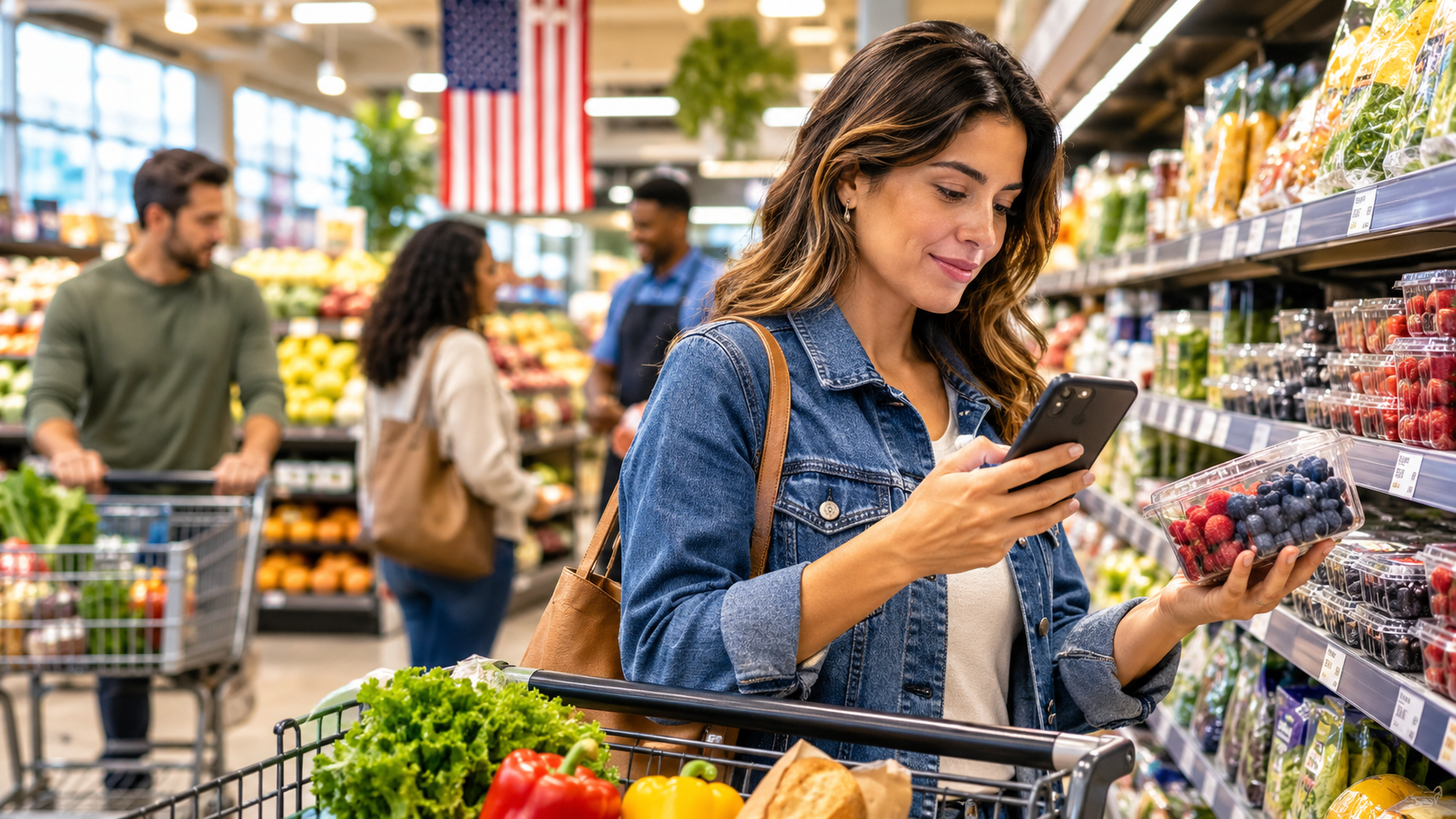
The American grocery shopper is changing the rules of supermarket competition. Price sensitivity, loyalty programs, digital engagement and artificial intelligence are redefining how consumers make purchasing decisions — and how retailers must compete, differentiate and grow.
By Diario Retail | U.S. Market Analysis
The American grocery shopper is entering a new era
The U.S. supermarket industry is facing a significant transformation. The way Americans shop for groceries is evolving, driven by economic pressure, changing household priorities, greater access to digital tools and increasingly sophisticated expectations around value.
Today’s grocery shopper is no longer choosing a supermarket based exclusively on price, proximity or product availability. Consumers are evaluating the complete shopping experience: how much they spend, how easily they find what they need, which benefits they receive through loyalty programs and how effectively a retailer understands their preferences.
As the industry enters the 2026 holiday shopping season, these changes are becoming increasingly relevant for supermarket operators, manufacturers and distributors.
According to FMI – The Food Industry Association’s 2026 research, 68% of shoppers are concerned about rising food prices, while 67% agree that grocery retailers try hard to offer options that help them stay within budget.
These findings reveal an important reality: value is no longer simply about offering the lowest price. It is about delivering a better overall proposition to the customer.
1. Value has become the new competitive battlefield
Price remains one of the strongest factors influencing grocery purchasing decisions, but the definition of value is becoming broader.
Consumers are comparing prices, adjusting shopping frequency, exploring different supermarket formats and looking for promotions that genuinely improve their purchasing power.
McKinsey’s The State of Grocery North America 2026 identifies a significant shift: 60% of consumers say their need to obtain good value has increased, while 71% prefer consistently lower everyday prices over frequent promotions built around higher regular prices.
This creates a new challenge for supermarket operators.
Competing exclusively through discounts can put additional pressure on already tight operating margins. Retailers need to identify which products influence customers’ perception of value, where promotional investments generate results and how to maintain customer loyalty without sacrificing profitability.
Private-label products, strategically selected promotions, fresh departments and competitive pricing on essential grocery items are becoming important components of this strategy.
The opportunity is to build a consistent value proposition that customers recognize every time they visit the store.
2. Loyalty programs are becoming a business strategy, not just a marketing tool
One of the most significant developments in American grocery retail is the growing importance of loyalty programs.
For many years, loyalty cards and discount memberships were primarily used to encourage repeat purchases. Today, they are becoming strategic tools for understanding customers, personalizing offers and strengthening the relationship between supermarkets and their communities.
Loyalty programs can provide retailers with valuable insights into purchasing frequency, product preferences, promotional response and customer behavior.
For retailers, the implications go beyond customer retention.
A well-designed loyalty strategy can help supermarkets better understand purchasing patterns, identify category opportunities, improve promotional effectiveness and develop more relevant communications.
The next competitive advantage will not necessarily belong to the supermarket with the largest rewards program, but to the retailer capable of turning customer information into meaningful commercial decisions.
3. Technology is transforming the shopping experience
Technology is becoming an increasingly important part of the grocery shopping journey, even when the final purchase takes place inside a physical supermarket.
Consumers are using retailer applications, websites, search engines and digital promotions before and during their shopping trips.
FMI’s U.S. Grocery Shopper Trends 2026 research reports that:
- 77% of grocery shoppers use digital technology before shopping.
- 71% engage with digital technology while shopping.
- 54% use retailer applications while shopping in physical stores.
These findings challenge the traditional distinction between physical and digital retail.
The supermarket remains central to the consumer experience, but its competitive environment increasingly extends beyond the store’s physical boundaries.
Retailers that integrate digital communication, personalized promotions, online discovery and in-store execution can create a more connected experience and increase opportunities to engage customers.
Artificial intelligence is also beginning to influence how consumers research food products, plan meals and make purchasing decisions.
For supermarkets, this development creates opportunities in customer intelligence, demand forecasting, assortment planning, promotional optimization and operational efficiency.
The challenge is not simply adopting new technology. It is identifying where technology can produce measurable business results.
4. Retail Media: The supermarket as a new media platform
Another important transformation is taking place inside the supermarket itself.
The physical store is increasingly becoming a commercial communication channel for brands.
Every aisle, shelf, checkout area, digital screen and promotional display represents an opportunity to connect manufacturers with consumers at the moment purchasing decisions are being made.
This is the foundation of Retail Media: transforming supermarket audiences, physical spaces and first-party data into measurable advertising and promotional opportunities.
For supermarket operators, this opens a potential additional revenue stream beyond traditional product sales.
For brands and suppliers, it creates opportunities to improve visibility, reach specific audiences and connect marketing investment with actual retail performance.
The opportunity is particularly relevant for independent and regional supermarket operators.
Retail Media does not have to be an exclusive model for the largest national chains. With the right commercial structure, technology and measurement capabilities, independent supermarkets can also participate in this evolving ecosystem.
5. The independent and Hispanic supermarket opportunity
The transformation of American grocery retail also creates an important opportunity for independent supermarkets and the Hispanic grocery sector.
These businesses operate close to their communities and frequently serve consumers whose purchasing preferences, cultural traditions, product expectations and shopping habits require a more localized approach.
Their proximity to customers can become a significant competitive advantage.
However, competing in an increasingly sophisticated retail environment requires access to information, technology, supplier relationships and commercial tools that historically have been more accessible to larger retail organizations.
Independent supermarkets need to move beyond simply managing daily operations. They must increasingly understand their customers, evaluate product performance, improve supplier relationships and explore additional ways to monetize their commercial assets.
The next stage of grocery retail development will depend not only on the size of a supermarket chain, but also on its ability to make better decisions with the information and resources available to it.
Daniel Esteban Novoa’s Perspective
 Daniel Esteban Novoa | Executive Vice President & Co-Founder, The Hispanic Retail Chamber of Commerce (HRCOC), Washington, D.C.
The future belongs to supermarkets that understand their customers
From the perspective of The Hispanic Retail Chamber of Commerce (HRCOC), the transformation of the American grocery shopper represents much more than a change in consumer behavior. It signals a new stage in the evolution of the supermarket industry and the need for stronger institutional support, technology adoption and business collaboration.
“The supermarket industry is entering a period in which understanding the customer will become just as important as managing products, pricing and inventory. Retailers need to recognize that every transaction generates valuable information that, when properly understood, can help them make better decisions and create new commercial opportunities.”
Novoa also highlights the institutional evolution of HRCOC and its commitment to supporting the sector through this transformation.
“The Hispanic Retail Chamber of Commerce has entered its third phase of expansion, with technology-driven services becoming one of our strategic priorities. Our objective is to accompany the supermarket industry through this evolution, connecting retailers with technological solutions, business intelligence, strategic partners and new commercial opportunities that can strengthen their competitiveness.”
He emphasizes that innovation and advanced technology should not be exclusive advantages of the largest retail chains.
“Independent and Hispanic supermarkets have something extremely valuable: their proximity to customers, their knowledge of local communities and their ability to adapt. The challenge is to connect those strengths with better information, technology and strategic supplier relationships. We believe these businesses should have access to the same type of innovation and business opportunities that are transforming the broader retail industry.”
Novoa also highlights the importance of collaboration between retailers, manufacturers, distributors and technology providers.
“The future of grocery retail will be built through collaboration. Supermarkets and suppliers need to move toward relationships that generate measurable value for both sides. Better information, more effective promotions, stronger customer engagement and new Retail Media opportunities can help create a more competitive and sustainable industry.”
Through its third expansion phase, HRCOC is strengthening its ecosystem of technology, intelligence, media, education and commercial services, reinforcing its role as a strategic platform serving the supermarket industry across the United States.
6. What supermarket retailers should prioritize next
The trends emerging in 2026 point toward a clear set of strategic priorities for supermarket operators.
| Strategic priority | Business opportunity |
|---|---|
| Customer intelligence | Understand purchasing patterns and customer needs |
| Pricing and promotions | Improve value perception while protecting margins |
| Loyalty programs | Increase retention and purchase frequency |
| Retail Media | Develop additional commercial revenue |
| AI and automation | Improve operational and commercial decisions |
| Supplier collaboration | Build measurable joint business opportunities |
| Omnichannel engagement | Connect digital discovery with physical shopping |
These priorities should not be treated as independent initiatives. Their real potential emerges when they are integrated into a coordinated business strategy.
A supermarket that understands its customers can make better assortment decisions. Better information can improve supplier negotiations and promotional planning. More relevant promotions can strengthen loyalty. And a stronger customer relationship can create additional opportunities for Retail Media.
This is where technology, information and commercial strategy converge.
The next competitive advantage: understanding the customer
The American grocery shopper is not abandoning the traditional supermarket. Physical stores continue to play a central role in food purchasing, product discovery and household decision-making.
What is changing is what consumers expect from those stores.
They want competitive prices, meaningful savings, convenient experiences, relevant promotions and a retailer that understands their needs.
For supermarket operators, the message is clear: competing in the next phase of grocery retail will require more than selling products.
It will require understanding customers, using information intelligently, developing stronger relationships with suppliers and creating new sources of business value.
The supermarket of the future will not simply be the place where consumers buy groceries. It will be a business platform that connects customers, brands, data, technology and commercial opportunities.
And that transformation is already underway.
DIARIO RETAIL
More than news. Strategic direction.
