





Within the same chain, each supermarket can operate like a different company. The difference is almost never in the location or the prices: it's in who manages the store. Evaluating them periodically is the most effective tool for aligning teams with the brand.
Any supermarket chain owner has experienced it. Two stores with the same logo, the same products, and the same prices. And yet, one runs like clockwork while the other feels like a completely different business. In the first, employees stay for years; in the second, the cashiers change every month. In one, customers greet the butcher by name; in the other, nobody knows who to ask for the cooking oil.
The explanation usually lies in the position: the store manager.
Each director builds their own company
A store manager doesn't just run a store. They decide how shifts are assigned, how mistakes are handled, who gets recognition, and what's acceptable. Over time, the team stops responding to the corporate identity and starts responding to the manager's identity. Their ideas, habits, and way of treating people end up defining the store's culture.
That's why, within the same chain, differences appear that can't be explained by the numbers: stores with much higher turnover than others, uneven sales between similar locations, and customer service that varies from one store to another. It's not a coincidence. Each store reflects who manages it.
Studies confirm it. According to Gallup, the direct supervisor accounts for at least 70% of the difference in employee engagement levels between teams. In other words, people don't leave companies, they leave their bosses. And in a supermarket, the most influential boss on a daily basis is the store manager.
Turnover also has an emotional cost
When a store experiences high staff turnover, the problem isn't just the cost of replacing each person. It's that the team never stops learning. Every new employee goes through a learning curve, and the sense of belonging, which only develops over time, never truly takes hold.
And the customer senses that. An employee who is happy at their company doesn't just go to work. They recommend products, share their knowledge, answer questions, and convey a sense of security and positive energy that makes the customer feel like they belong at the supermarket. That connection is what transforms an occasional shopper into a loyal customer.
The opposite is also true: a team that doesn't feel a sense of belonging can't transmit that sense of belonging. No promotion can replace an employee who is proud of where they work.

Why evaluate directors?
If everything starts at the top, then the place to begin correcting is at the top. That's why more and more chains are adopting regular performance reviews for their store managers, with a clear objective: to ensure that each manager knows how their work is measured, receives concrete feedback, and aligns with the brand's values and standards, rather than allowing each store to develop its own unique identity.
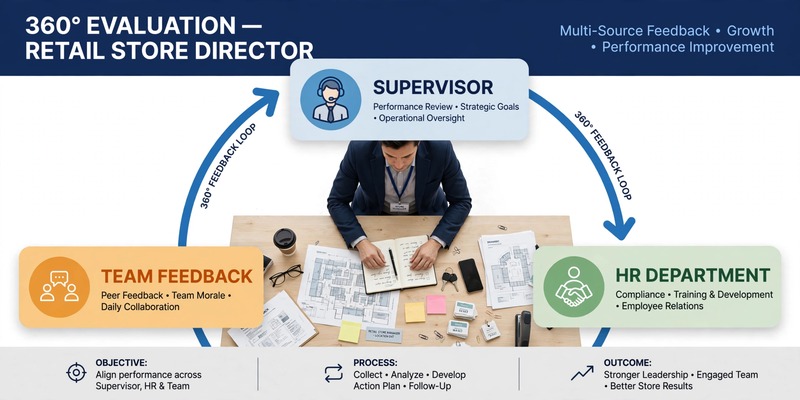
The most comprehensive evaluations are the so-called 360° evaluations, because they gather the perspectives of several parties on the same director: their direct supervisor or the operations department, the human resources department, and their own team, who respond anonymously. Each person rates only what they observe in their daily work, and a single score is obtained at the end.
The parameters measured go far beyond sales. They include team retention and stability, shift coverage and overtime management, new employee onboarding and training, safety and regulatory compliance, leadership and communication, a respectful work environment and conflict resolution, sales floor operations, customer experience at checkout, performance indicators, and the example the manager sets for their team.
The process ends with a feedback conversation in which the director's strengths, areas for improvement, and specific commitments, including the responsible party and date, are reviewed and signed.
The surprise of the first time
For many managers, the first evaluation comes as a surprise, and not always a pleasant one. This is normal: for years no one has asked their teams how they are managing them, and suddenly they receive an opinion they weren't expecting.
But the discomfort doesn't last long. With the second and third evaluations, the process becomes routine, and the managers themselves begin to notice the change in their teams: fewer resignations, fewer conflicts, more stable shifts, and a different work environment. At that point, the results cease to be a promise and become tangible.
What changes in practice
The results of a well-executed evaluation process are measurable. The difference in turnover between stores narrows, overtime expenses decrease, incidents and customer complaints diminish, and sales across locations become more comparable. But the most valuable outcome is something else entirely: all the stores in the chain begin to feel like a single company, with a shared identity and a consistent approach to customer service.
The mistake of staying on the payroll
Herein lies a common mistake in the industry. Many chains work with payroll or staffing companies that simply process payroll or assign people to jobs. They fulfill their obligations by paying on time and filling vacancies, but they don't follow up, propose improvements, or help build team loyalty. It's neither their business nor their concern.
The key difference lies in having a human resources specialist partner for the retail sector , someone who understands supermarket operations and works alongside the chain to evaluate its leaders, retain its staff, and build a shared identity. Because a brand isn't built solely with identical signs and uniforms: it's built with teams who feel a sense of belonging.
The next time you compare your store results, it's worth asking yourself a simple question: Are you seeing differences between locations, or differences between managers?

Marcela Primo
CEO · LEEM PRO Staffing
marcela@leempro.com
LEEM PRO Staffing has been recognized by the White House, the United States Senate, and the Florida Senate for its support of the Hispanic community, and holds The Hispanic Designation Certificate Retail Chamber of Commerce as a staffing company specializing in payroll and human resources for the retail sector .
