




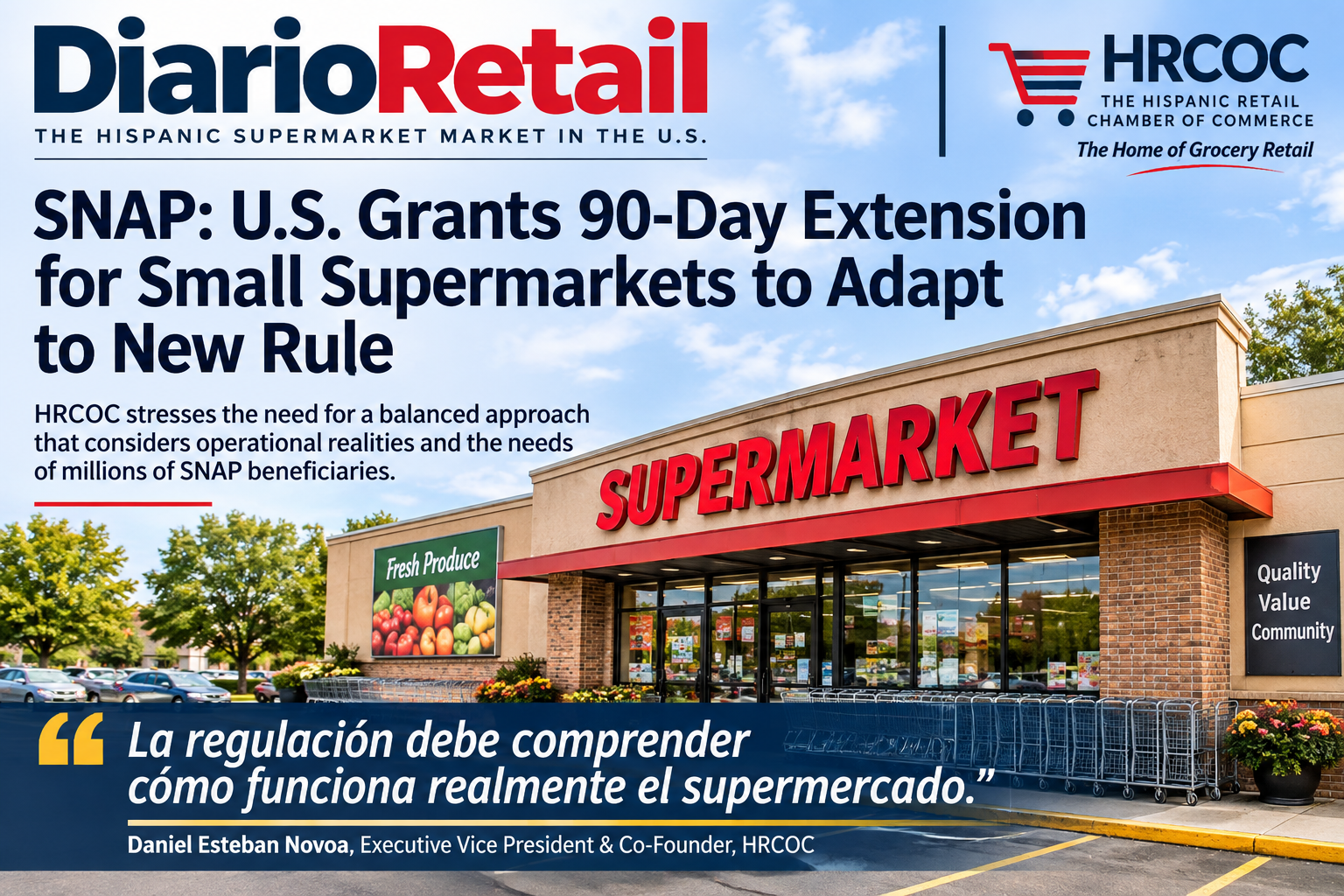
“Regulation must understand how supermarkets actually operate.”
HRCOC welcomes the additional time granted to retailers and calls for a balanced implementation that recognizes the operational realities of independent supermarkets while protecting access to food for millions of consumers.
The implementation of a new federal regulation affecting the Supplemental Nutrition Assistance Program (SNAP) will receive an additional 90 days before the new requirements take effect for affected retailers.
The extension follows requests from different industry organizations and representatives of the retail sector, who raised concerns about the original implementation timeline and the need to provide supermarkets and convenience stores with sufficient time to adjust their operations. Several organizations had advocated for an extension of up to six months.
The discussion highlights a fundamental issue for the U.S. grocery industry: how to implement public policies designed to improve food availability and product variety without creating operational challenges that could affect the ability of independent retailers to remain part of the SNAP program.
A Shared Concern Across the Retail Industry
The new requirements seek to ensure that participating SNAP retailers offer a broader selection of eligible food products. However, the operational impact will not be the same for every business.
Independent supermarkets, neighborhood grocery stores, and convenience retailers operate with different business structures, sales-floor capacities, supply chains, inventory systems, and financial resources compared with large national chains.
Industry representatives have warned that implementing the new requirements without sufficient preparation time could create unintended consequences. Some retailers may even reconsider their participation in SNAP rather than absorb additional operational costs and compliance requirements.
This possibility deserves particular attention because independent supermarkets play an important role in many communities, especially in neighborhoods where they provide convenient and accessible options for everyday grocery shopping.
HRCOC’s Position: Regulation and Operational Reality Must Move Forward Together
The Hispanic Retail Chamber of Commerce (HRCOC) believes that the requests for an implementation delay, supported by different sectors of the industry, reflect legitimate concerns that deserve consideration.
Modernizing food standards and promoting greater access to a wider variety of nutritious products are important objectives. However, public policies must also account for the actual conditions under which affected retailers operate.
For many independent supermarkets, particularly those serving Hispanic and multicultural communities, meeting new requirements may involve changes to purchasing strategies, product assortment, shelf allocation, inventory management, storage capacity, and supplier coordination.
The additional 90 days should therefore be viewed as an opportunity to support a more orderly transition.
HRCOC believes it is essential to provide retailers with clear guidance regarding final requirements, compliance standards, and available support mechanisms. Continued dialogue among government authorities, industry associations, retailers, and suppliers will also be critical.
The objective should be to achieve the intended public policy goals without weakening the participation of independent supermarkets in a program that plays an important role in food access for millions of Americans.
Daniel Esteban Novoa: “Regulation Must Understand How Supermarkets Actually Operate”
 Daniel Esteban Novoa, Executive Vice President & Co-Founder of The Hispanic Retail Chamber of Commerce, shared his perspective:
“We believe it is positive that additional time has been made available for independent supermarkets to prepare for these changes. The requests for an extension, supported by different industry sectors, demonstrate that there is a shared concern about the timeline and the conditions required for successful implementation.
There is something we must keep in mind: a supermarket is not simply a point of sale. It is an operating structure that depends on suppliers, logistics, inventory, physical space, human resources, and continuous commercial planning.
When a requirement affecting product assortment changes, the impact goes far beyond adding new items to the shelves. It can also affect costs, product availability, inventory turnover, storage capacity, and commercial decisions.
From our perspective, the challenge is to find the right balance between the objectives of improving nutrition and the economic and operational realities of supermarkets.
We must avoid a situation in which a regulation intended to expand access to better food choices ends up producing the opposite result: some retailers withdrawing from the program and their customers losing a nearby option for accessing these benefits.
Independent supermarkets are an essential part of the commercial fabric of many American communities. Listening to their experience and supporting their transition is also a way to strengthen the food retail system.”
An Opportunity to Strengthen Dialogue Between Industry and Government
The 90-day extension does not, by itself, resolve all the challenges associated with the new regulation. However, it creates an important opportunity to improve the implementation process.
HRCOC believes this period should be used to strengthen communication among government authorities, industry associations, supermarkets, and suppliers, working toward solutions that consider the different dimensions of grocery retail operations.
The U.S. grocery industry is made up of businesses of different sizes, structures, and operational capabilities. Recognizing this diversity is essential to developing policies that can be implemented effectively and sustainably.
Improving food access and strengthening independent supermarkets should not be competing objectives. They should be part of the same strategy.
The Hispanic Retail Chamber of Commerce (HRCOC)
The Home of Grocery Retail
Washington, D.C.
