


From the physical aisle to the digital shelf: how data, artificial intelligence, and product availability are transforming purchasing decisions.
A Discussion Brief by The Hispanic Retail Chamber of Commerce (HRCOC)
The grocery retail industry is undergoing a transformation that goes far beyond introducing technology into store operations. Competition is expanding into a new territory: the digital environment where consumers discover, compare, evaluate, and decide which products to purchase, sometimes before they even walk into a store.
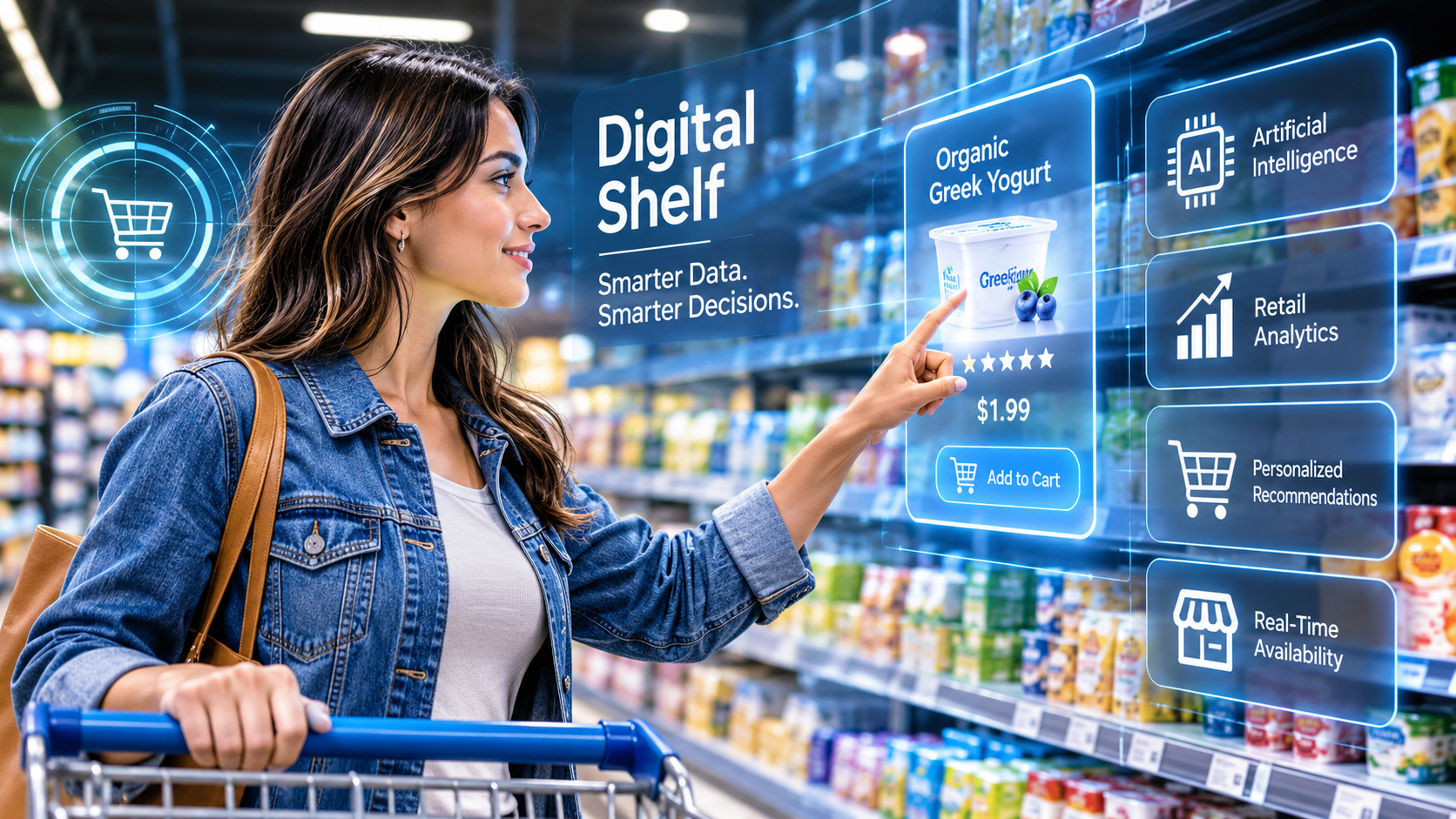
This evolving landscape is bringing increasing attention to the concept of the Digital Shelf, a dimension of retail traditionally associated with e-commerce and online product listings, but now taking on a much broader role with the rise of artificial intelligence, digital assistants, and changing consumer shopping habits.
The shelf is no longer simply the physical space where products compete for consumers’ attention. It is also the entire digital information ecosystem that allows products to be discovered, understood, recommended, and ultimately selected.
When Artificial Intelligence Starts Influencing What Consumers See
Consider a scenario that is becoming increasingly realistic: a consumer asks an AI assistant to recommend products for preparing a healthy dinner, within a specific budget and taking certain dietary preferences into account.
The response may include recipes, specific brands, and a suggested shopping list.
Throughout this process, the consumer may never visit a supermarket’s website or directly browse a manufacturer’s product catalog. Nevertheless, certain products will have been selected for recommendation, while others may have been excluded.
What determines that selection?
The quality, availability, accuracy, and structure of each product’s digital information.
For a product to compete in this new environment, having a strong brand or a prominent position on a physical shelf is no longer enough. It must also have complete and reliable digital information: descriptions, images, ingredients, nutritional attributes, dietary considerations, pricing, availability, and specific product characteristics.
Artificial intelligence cannot independently verify what is happening on a physical supermarket shelf. It relies on information that is available, accessible, and understandable.
As a result, data quality is becoming a competitive advantage in grocery retail.
A Shared Challenge for Supermarkets, Brands, and Technology Providers
The evolution of the Digital Shelf creates shared responsibilities across the retail ecosystem.
Manufacturers and brand owners must ensure that their products have complete, accurate, and consistently updated digital information.
Supermarkets, in turn, must ensure that this information is integrated into their systems, product catalogs, commercial platforms, and digital channels, including accurate product availability at the individual store level.
Outdated information, incomplete product attributes, classification errors, and poor synchronization between inventory systems and digital platforms can affect product visibility and result in missed commercial opportunities.
This requires greater integration between retail operations, suppliers, technology, and data management.
The transformation is not simply about adopting artificial intelligence. It is about preparing systems, processes, and information so that AI can generate meaningful business results.
HRCOC Brings This Discussion into Its Institutional Agenda
For The Hispanic Retail Chamber of Commerce (HRCOC), the digital transformation of grocery retail is an established priority and an ongoing subject of strategic discussion with the industry’s key stakeholders.
Through its HRID program, the Chamber considers it particularly important to encourage the exchange of knowledge, experience, and solutions related to the technological evolution of the grocery retail industry.

Digital Shelf, Retail Media, artificial intelligence in grocery operations, data management, consumer experience, and commercial platform integration are all areas that deserve to be addressed from a comprehensive industry perspective.
HRCOC brings together technology-focused members and specialized service providers whose capabilities are directly connected to the actual needs of the grocery retail market. This network creates opportunities to connect supermarkets with professional expertise, tools, and solutions addressing specific challenges in operations, commercialization, efficiency, and competitiveness.
The objective is not to promote technology for its own sake, but to help supermarkets identify the solutions they need, understand their potential impact, and connect with qualified providers capable of supporting implementation.
The Chamber believes that technology transformation must be aligned with the operational and economic realities of each supermarket, regardless of its size or investment capacity.
Daniel Esteban Novoa: “The Next Competitive Battle in Grocery Retail Will Also Be Fought in the Data Environment”
 From the perspective of Daniel Esteban Novoa, Executive Vice President & Co-Founder of The Hispanic Retail Chamber of Commerce, the development of the Digital Shelf represents a fundamental shift that the grocery industry must begin incorporating into its strategic decisions.
“For many years, supermarket competition has been heavily concentrated on physical product placement, pricing, supplier negotiations, and the ability to bring consumers into stores. Those factors remain fundamental, but we are now facing an additional dimension of competition.
A product needs to be well positioned on the physical shelf, but it must also be visible, recognizable, and accurately interpreted in the digital environment. This becomes even more important as consumers increasingly delegate part of their purchasing decisions to artificial intelligence assistants.
I believe one of the major challenges for supermarkets, particularly independent and regional operators, will be understanding that technology is no longer an optional addition or a trend reserved for the largest chains. It is becoming a tool for competing, improving management, and developing new commercial opportunities.
At HRCOC, this is precisely the direction we are working toward. We have entered a third phase of institutional expansion, in which technology services are among our priorities for supporting the evolution of the grocery retail industry.
Our vision is that a Chamber must remain connected to what the market actually needs. That is why we are incorporating technology companies, developers, and specialized service providers capable of delivering practical solutions to supermarkets and their suppliers.
This is not simply about talking about artificial intelligence or digital transformation. It is about connecting capabilities, building strategic relationships, and helping turn these tools into better decisions and new business opportunities.”
The Debate the Industry Needs to Have
The Digital Shelf raises important questions that deserve discussion among supermarkets, manufacturers, distributors, and technology companies:
- Are supermarket digital catalogs prepared to respond effectively to inquiries from artificial intelligence assistants?
- How can the industry ensure that product information, pricing, and availability remain accurate and up to date?
- What responsibilities should manufacturers and brand owners assume, and which belong to supermarkets?
- How can independent supermarkets improve their digital visibility and compete on a more level playing field?
- What opportunities emerge from integrating Digital Shelf, Retail Media, loyalty programs, and data analytics?
- How can digital information be transformed into new commercialization opportunities and greater profitability?
These questions do not have a single answer, but they point in one direction: the future of grocery retail will require increasing integration between physical operations, digital systems, and business intelligence.
HRCOC’s Position
The transformation of retail cannot remain limited to technology developers or large supermarket chains with the resources to implement large-scale solutions.
It must be an open conversation involving the entire grocery retail ecosystem.
As an organization connected with supermarkets, brands, suppliers, and service providers across the U.S. market, HRCOC seeks to contribute to this process by promoting industry dialogue, bringing knowledge closer to the market, and facilitating connections between the needs of the industry and the capabilities of those equipped to address them.
Because the next evolution of grocery retail will not be defined solely by what happens inside supermarket stores, but also by the quality of the information, technology, and decisions connecting every product with the consumer.
The Hispanic Retail Chamber of Commerce — The Home of Grocery Retail. info@hispanicretailchamber.org
