




By Diario Retail | HRCOC Strategic Counsil
The meat market is undergoing a transformation that goes far beyond price changes. Today’s consumers are changing the way they choose proteins, cuts, formats, and consumption occasions—and within this transformation, Hispanic consumers in the United States represent one of the most diverse and culturally relevant segments.
The key takeaway is clear: there is no longer a single definition of value in the meat category.
Consumers may prioritize price and convenience for an everyday meal, yet be willing to pay more for a premium cut for a family celebration. They may choose chicken for convenience, beef for a cookout, pork for a traditional recipe, or specific cuts and variety meats because they are part of a recipe passed down through generations.
Culture, family heritage, and the occasion for consumption continue to play a significant role.
The Hispanic Consumer Is Not a Homogeneous Consumer
Referring to the “Hispanic consumer” as a single segment can lead to misguided decisions.
The Hispanic population in the United States includes consumers with Mexican, Central American, Caribbean, and South American roots, as well as different levels of acculturation, generations, income levels, and culinary habits.
As a result, the preferences of a Mexican consumer may differ significantly from those of a Cuban, Puerto Rican, Colombian, Venezuelan, Argentine, or Central American consumer.
Research on Hispanic meat consumption has demonstrated this diversity, with Cuban and Puerto Rican consumers showing different preferences from Mexican and Central American consumers.
For the industry, this means that the opportunity is not simply to offer “Latino” products, but to understand the different culinary cultures that make up the Hispanic market.
Beef: Tradition, Versatility, and Occasion
Beef continues to hold a particularly important position among Hispanic consumers.
Research on meat consumption patterns among Hispanic households in the United States has found a significant share of beef within household meat spending, followed by pork and poultry.
But more important than the category itself is the variety of uses.
Consumers may look for:
- Ground beef for tacos, meatballs, picadillo, and family meals.
- Cuts for grilling and pan-searing.
- Thinly sliced cuts for fajitas and quick preparations.
- Cuts for stews and slow cooking.
- Beef for cookouts and celebrations.
- Specific cuts associated with particular regional cuisines.
This diversity also explains why cuts historically considered secondary can have a very different value within certain communities.
Beef tongue, tripe, oxtail, beef feet, and other variety cuts are part of traditional dishes across different Latin American cultures. Demand for these products is not necessarily driven by price; in many cases, it reflects authenticity, tradition, and flavor.
Pork: A Protein Deeply Connected to Latino Culture
Pork is another strategically important protein.
Its relevance is closely tied to numerous Latin American and Caribbean cuisines, where it appears in family meals, celebrations, and everyday cooking.
Research from the National Pork Board has highlighted the strong cultural connection between pork and Hispanic consumers, as well as the importance of offering greater variety and authenticity in cuts targeting this segment.
Ribs, shoulder, chops, bacon, ham, stew meat, and other cuts can carry different meanings and culinary uses depending on the consumer’s cultural background.
Therefore, the same product may compete primarily on price in one segment and on authenticity in another.
Chicken: Convenience, Family, and Affordability
Chicken represents another fundamental part of protein consumption.
Its price, versatility, and ease of preparation make it particularly relevant for family meals.
But cultural differences also matter.
Breasts, thighs, drumsticks, and wings can serve very different needs, while some consumers may actively seek cuts that are less common in mainstream offerings.
The category highlights an important characteristic of Hispanic consumers: the purchase decision is not determined solely by price per pound, but by the culinary value and meal potential consumers perceive in the product.
Cuts Reflect Culture
One of the biggest challenges for the meat industry is understanding that a “cut” or “product” does not necessarily mean the same thing to every consumer.
A cut may be considered secondary by one consumer and highly desirable by another.
For example, research has historically identified a preference among Hispanic consumers for thinner cuts, particularly for preparations such as fajitas, carne asada, and other traditional dishes.
Regional differences also exist. Previous research has found that Caribbean consumers can have different preferences from South American consumers regarding the thickness and format of certain meat products.
The conclusion for the industry is clear:
It is not enough to sell meat. The industry must understand how consumers want to use it.
Country of Origin Also Matters
Within the Hispanic market, the origin of meat can carry additional meaning.
The United States remains a fundamental reference due to availability, infrastructure, traceability, and supply. However, Latino consumers may also recognize and value products associated with specific countries of origin and meat traditions.
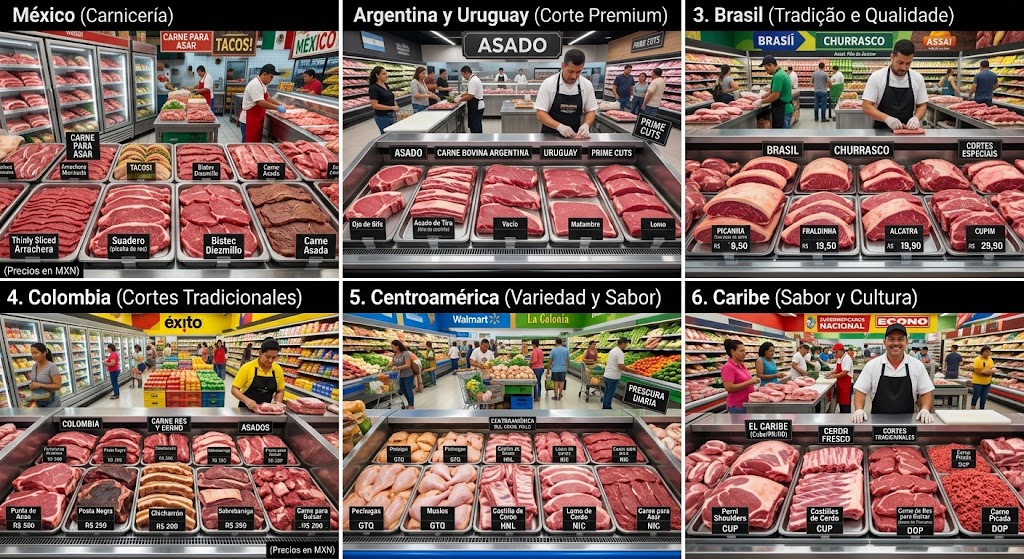
Among the origins that may have relevance within the broader Latin American culinary landscape are:
Mexico, particularly associated with tacos, carne asada, and regional preparations.
Argentina and Uruguay, strongly connected to grilling culture, premium beef, and traditional cuts.
Brazil, with a strong beef-consuming culture and distinctive preparation styles.
Colombia, with its own beef culture and preferences for grilling and traditional preparations.
Central America, where beef, pork, and poultry are deeply integrated into everyday cuisine.
The Caribbean, particularly Cuba, Puerto Rico, and the Dominican Republic, where pork and specific beef cuts play an important cultural role.
Country of origin, however, should not automatically be interpreted as a purchase preference. Perceived quality, freshness, price, availability, traceability, and authenticity ultimately influence the buying decision.
Quality and Price: The New Balance
Consumers are allocating their food budgets more strategically.
For certain occasions, affordability is the priority. For others, consumers are willing to pay more for quality, origin, a specific cut, or a better overall experience.
Recent research on the meat market indicates that consumers are becoming more deliberate in how they allocate their spending: some occasions call for predictability and savings, while others justify higher quality.
This creates an important opportunity for the industry:
the market is not simply dividing between price-driven and premium consumers; it is increasingly segmenting around consumption occasions.
The same consumer may be highly price-sensitive during the week and become a premium buyer on a weekend, during a family gathering, celebration, or cookout.

New Generations, New Expectations
Millennials and Gen Z are progressively reshaping expectations around the meat category.
In addition to price and taste, factors such as convenience, flavor exploration, digital information, sustainability, and quality are becoming increasingly relevant.
This is particularly important within the Hispanic market, where younger generations can combine family recipes and cultural traditions with consumption habits developed in the United States.
The result is a hybrid consumer:
traditional in flavor, but modern in the way they shop, discover information, and consume.
The Opportunity Is to Understand the Consumer, Not Label Them
The future of the meat category within the Hispanic market will not be determined simply by adding “ethnic” products to the assortment.
The real opportunity lies in understanding:
what each community consumes, which cuts they use, how they cook, what occasions drive their purchases, what they consider quality, how much they are willing to pay, and what the product’s origin means to them.
The industry also has a technological advantage that did not exist a few years ago.
Purchase data, loyalty programs, artificial intelligence, and advanced analytics increasingly allow companies to identify consumption patterns with greater precision and adapt assortments, formats, promotions, and communications to actual consumer behavior.
Demographics can indicate where an opportunity exists.
But consumers ultimately tell the industry what they want.
The perspective of HRCOC Strategic Council
For HRCOC Strategic Council, the Hispanic market represents one of the most interesting laboratories for understanding where the protein business is headed in the United States.
Its diversity requires the industry to move beyond simplified categories and begin thinking in terms of cultural micro-segments, consumption occasions, generational preferences, and perceived value.
Meat will remain an essential category.
But the next stage of growth will not depend solely on producing more.
It will depend on better understanding who the industry is selling to, what they want to cook, which traditions they want to preserve, and what new experiences they are seeking.
Hispanic consumers are not abandoning their traditions. They are transforming them. And the meat industry will have to transform with them.