




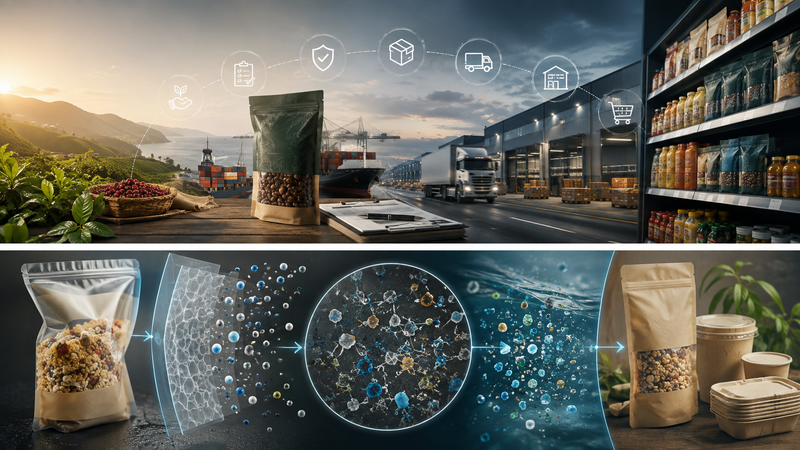
Regulatory compliance, packaging requirements, pricing structures and B2B logistics remain among the most. critical challenges facing emerging Latin American brands seeking sustained access to the U.S. retail market. The Hispanic Retail Chamber of Commerce outlines the key pillars for a successful market-entry strategy.
FOOD EXPORTS TO THE U.S.: Growing Demand for Clean-Label
and Organic Products from Latin America
U.S. consumer demand for food and beverages with authentic origin, clean-label ingredients, added value and organic credentials continues to create opportunities for Latin American producers.
However, moving a product from its country of origin to a U.S. supermarket shelf involves far more than producing a high-quality food or beverage. Import compliance, labeling, packaging, pricing, distribution and fulfillment requirements must all work together before a product can achieve sustainable retail distribution.
In response to these challenges, the Hispanic Retail Chamber of Commerce (HRCOC) and Diario Retail are presenting the Market Access Playbook, a strategic framework designed to help identify and address the critical barriers that can prevent Latin American products from successfully entering and remaining within the U.S. retail ecosystem.
FDA COMPLIANCE AND STATE REGULATIONS: Understanding the Regulatory Barriers to U.S. Retail
One of the first challenges facing an international food exporter is regulatory compliance.
Meeting the requirements of the U.S. Food and Drug Administration (FDA), together with applicable federal, state and local regulations, requires technical preparation and product-specific compliance protocols.
Key considerations include:
• Food Facility Registration and U.S. Agent: Foreign food facilities subject to FDA registration requirements must register with the FDA and designate a U.S. agent to serve as the communication link between the foreign facility and the agency.
• Food Date Labeling: Federal law generally does not require manufacturers to place qualitybased date labels on packaged foods, with certain exceptions. FDA and USDA currently
encourage the voluntary use of "Best if Used By" to communicate peak quality.
• California AB 660: Beginning July 1, 2026, California requires covered food products to use standardized terminology for quality and safety dates and prohibits consumer-facing "Sell By" dates, subject to specified exemptions.
• Food Safety and Traceability: Depending on the product and applicable regulations, exporters
may need documented preventive controls, HACCP systems where applicable, supplier controls, traceability procedures and supporting laboratory or safety documentation.
Regulatory compliance should therefore be evaluated before production and shipment, rather than after the product has already arrived in the United States.

SUSTAINABLE PACKAGING AND CATEGORY MANAGEMENT:
Adapting the Product for the U.S. Consumer
A product that performs well in a Latin American market does not necessarily require the same
presentation, packaging configuration or merchandising strategy to succeed on a U.S. supermarket shelf.
Exporters should evaluate:
• Nutrition Facts and Labeling Requirements: Products must comply with applicable FDA foodlabeling requirements, including Nutrition Facts, ingredient declarations and allergen labeling. Spanish-language or bilingual packaging may also be strategically valuable in markets with significant Hispanic consumer populations, although it is not a universal federal requirement.
• Shelf-Ready Packaging (SRP): Retailers increasingly seek packaging configurations that facilitate efficient stocking and merchandising while reducing handling time and labor.
• Format and Portion Size: Package sizes, serving formats and price points should be evaluated against category benchmarks and U.S. consumer purchasing behavior.
• Clean-Label Positioning: Where substantiated and legally permitted, certifications and claims such as Organic, Non-GMO or Gluten-Free can strengthen a product's positioning. Such claims must meet the applicable U.S. regulatory and certification requirements.
The objective is not simply to "translate" a product for the U.S. market. It is to adapt the entire retail proposition.
RETAIL TREND: THE SHIFT TOWARD LOWER-PLASTIC AND MORE RESPONSIBLE PACKAGING
Packaging sustainability is becoming an increasingly important consideration for retailers, brands and consumers.
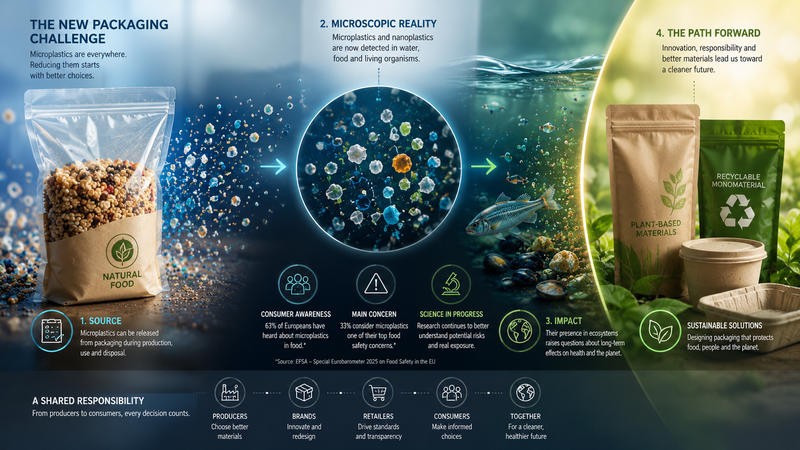
Plastic pollution has become a global environmental issue, while scientific and regulatory attention toward microplastics and nanoplastics continues to increase. Estimates indicate that more than 24 million metric tons of plastics leak into land, rivers and oceans globally each year.
Microplastics have also been detected in food, drinking water and ecosystems, although important scientific uncertainties remain regarding human exposure and long-term health effects. EFSA continues to identify significant research gaps in this area.
Several developments are worth monitoring:
• Consumer awareness: EFSA's 2025 Special Eurobarometer on Food Safety found that 63% of EU citizens had heard about microplastics in food, while 33% identified them as one of their main food-safety concerns.
• U.S. research and regulatory attention: The EPA's developing Contaminant Candidate List 6 (CCL 6) includes microplastics among the chemical groups selected for further evaluation under the Safe Drinking Water Act framework. This does not mean that a federal drinking-water standard for microplastics currently exists.
• Federal health research: In April 2026, HHS's Advanced Research Projects Agency for Health (ARPA-H) launched STOMP — Systematic Targeting Of MicroPlastics, a $144 million program focused on measuring, researching and developing approaches to address microplastics and nanoplastics in the human body.
• Food-contact materials: EFSA's October 2025 literature review examined the release of microand nanoplastics from food-contact materials during use and highlighted the need for additional research.
For Latin American exporters, the strategic implication is clear: packaging decisions should increasingly consider material efficiency, recyclability, regulatory direction, consumer expectations and retailer sustainability requirements.
DISTRIBUTION AND RETAIL MARGIN STRUCTURE: Understanding
the Financial Reality of the U.S. Grocery Channel
Successful market entry also requires understanding the economics of the U.S. grocery channel.
A common mistake among international exporters is to establish pricing based primarily on the FOB cost, without modeling the complete channel economics between the producer and the final consumer.
A preliminary pricing model should consider:
• Distributor Margin: Depending on the product, channel and distribution model, a planning range of approximately 20%–30% is commonly used for distributor margins.
• Retailer Margin: Grocery retailers may operate with gross-margin expectations that vary
substantially by category, format and product. Planning ranges of approximately 30%–50% are
commonly used as a starting point, but actual retailer requirements must be validated on a caseby-case basis.
• Trade and Operating Costs: Exporters should model potential costs such as promotional
allowances, introductory programs, broker commissions, free fills, slotting or setup fees where
applicable, retailer advertising, discounts, logistics charges and other trade-spend requirements.
•Landed Cost: The relevant calculation is not simply FOB. The exporter should understand the landed cost, including freight, insurance, customs-related costs, warehousing and other
expenses required to place the product in the U.S. distribution system.
The key question is not simply, "Can we sell this product in the United States?"
It is:
"Can the product reach the shelf at a price that works economically for the producer, distributor, retailer and consumer?"
B2B LOGISTICS AND OTIF: Protecting Supply Continuity and Shelf Presence
Winning the first purchase order is only the beginning.
Maintaining availability, replenishment and service levels is critical to building a long-term relationship with a U.S. retailer.
Key operational considerations include:
• OTIF — On Time, In Full: Retailers increasingly monitor supplier performance through delivery and fulfillment metrics. Late or incomplete shipments can lead to deductions, chargebacks, reduced confidence and, depending on contractual terms, further commercial consequences.
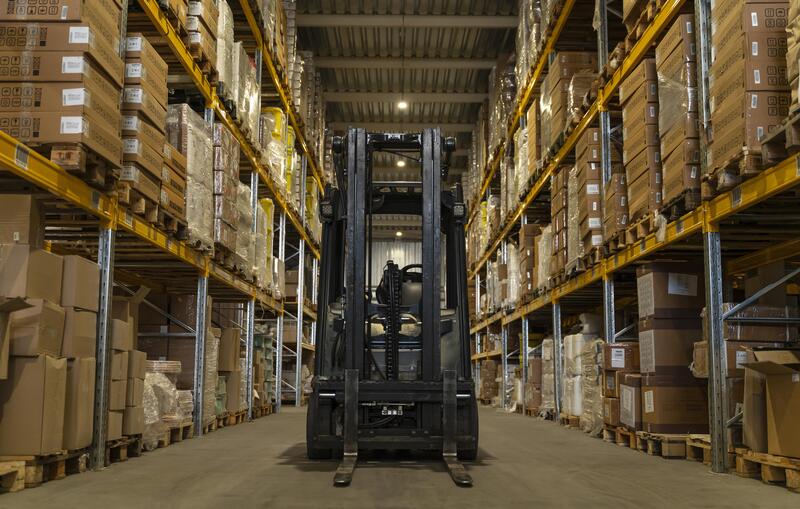
• U.S.-Based Inventory: For certain products and channels, maintaining safety stock through a qualified third-party logistics provider (3PL) can help exporters respond to retailer replenishment requirements and reduce supply-chain risk.
• Load Consolidation: For small and medium-sized enterprises, consolidated shipments can reduce logistics costs per case and improve the economics of entering the U.S. market.
• Scalable Fulfillment: The logistics model should be designed not only for the first shipment, but for the volume and service levels required if the product succeeds.
As a result, logistics should be considered part of the market-access strategy, rather than an activity that begins after the buyer places an order.
"International expansion is no longer simply an additional option for Latin American
producers; for many companies, it is a path to achieving scale. Success in the United States depends not only on product quality, but also on the operational discipline required to execute import, compliance, pricing and distribution processes effectively," said the Communications Directorate of the Hispanic Retail Chamber of Commerce.
RETAIL INSIDERS CLUB: THE HRCOC INITIATIVE FOR MARKET FEASIBILITY ASSESSMENT
The Market Access Playbook reinforces the Hispanic Retail Chamber of Commerce's commitment to serving as a strategic bridge between Latin America's high-value food and beverage supply and the U.S. retail market.
Through the HRCOC's Market Access Program, Latin American producers can gain access to structured market assessments, business-development opportunities, buyer introductions and potential integration into the Chamber's purchasing and retail ecosystem.
The objective is to help producers, exporters and distributors validate commercial feasibility before committing significant resources to U.S. market entry.
The Retail Insiders Club provides an additional platform for companies seeking market intelligence, business connections and a deeper understanding of the U.S. grocery environment.
PRESS CONTACT, INQUIRIES AND MEMBERSHIP
Email: info@hispanicretailchamber.org
Website: url HRCOC https://www.hispanicretailchamber.com/
Location: Washington, D.C.,
REFERENCE SOURCES
1- Hispanic Retail Chamber of Commerce & Diario Retail: Market Access Playbook: The Roadmap for Latin American Products to Reach U.S. Grocery Shelves, Washington, D.C., August 2026.
2 - U.S. Food and Drug Administration (FDA): Food Facility Registration and U.S. Agent
requirements.
3 - U.S. Food and Drug Administration (FDA) & U.S. Department of Agriculture (USDA): Food
Date Labeling guidance and 2024 Request for Information.
4 - California Department of Food and Agriculture (CDFA): AB 660 Food Date Labeling
requirements, effective July 1, 2026.
5 - U.S. Environmental Protection Agency (EPA): Contaminant Candidate List 6 and microplastics.
6 - U.S. Government Accountability Office (GAO): Science & Technology Spotlight: Microplastics in the Body and Environment, GAO-26-109098, July 15, 2026.
7 - U.S. Department of Health and Human Services / ARPA-H: Systematic Targeting Of MicroPlastics (STOMP), April 2026.
8 - European Food Safety Authority (EFSA): 2025 Eurobarometer on Food Safety in the EU.
9 - European Food Safety Authority (EFSA): Literature review on micro- and nanoplastic release from food contact materials during their use, October 21, 2025.
10 - Illinois General Assembly: Public Act 103-0934, Small Single-Use Plastic Act.
