





Daniel Esteban Novoa
Co-Founder & Executive Vice President
The Hispanic Retail Chamber of Commerce
For many years, international expansion was viewed as a goal reserved for large corporations with substantial financial resources, complex organizational structures, and established operations across multiple countries. For most companies, especially in Latin America, entering foreign markets was considered a long-term aspiration—desirable, but not essential.
Today, that reality has changed dramatically.
In an economic environment defined by volatility, technological transformation, shifting consumer behavior, and increasing global competition, internationalization is no longer a strategic option—it has become a business necessity.
Companies that rely exclusively on a single market face greater risks than ever before. Regulatory changes, economic fluctuations, political developments, and shifts in consumer demand can significantly impact performance within a matter of months. Diversifying into new markets is no longer simply a growth strategy; it is a business resilience strategy.
The World Has Become Smaller
Digitalization, global logistics networks, and new commercial platforms have significantly reduced the barriers to international trade.
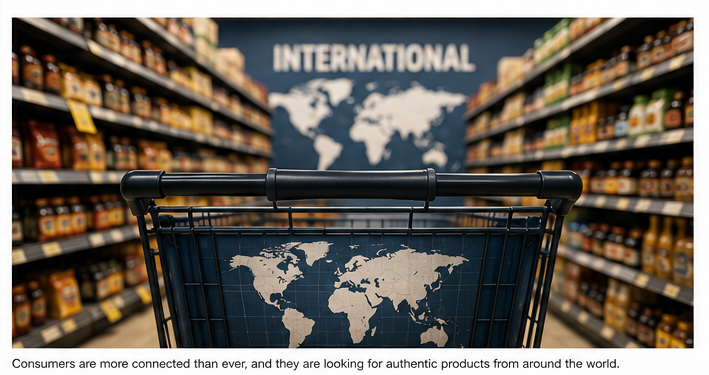
Today, a coffee producer in Colombia, a food manufacturer in Peru, or a cosmetics brand in Argentina can connect with buyers in the United States, Europe, or Asia more easily than at any other time in history.
However, gaining access to a market does not automatically translate into success.
True internationalization requires strategy, market knowledge, and adaptability. It involves understanding local consumers, complying with regulatory requirements, building efficient distribution channels, and developing sustainable commercial relationships.
The companies that understand this distinction are the ones that transform occasional exports into long-term market presence.
The United States Remains the Most Attractive Market
Despite ongoing economic and political changes, the United States continues to represent one of the most significant opportunities for Latin American companies.
With more than 340 million consumers, one of the world’s largest economies, and a Hispanic population exceeding 65 million people, the market potential remains extraordinary.
Yet many companies continue to underestimate one critical fact: the United States is not a single market.
Each state has its own demographic profile, consumer preferences, cultural influences, and retail dynamics. What succeeds in Florida may require a completely different approach in Texas. What works in California may need significant adaptation for Illinois or New York.
The challenge today is not simply entering the U.S. market—it is developing a smart and scalable strategy for long-term positioning and growth.
The Competitive Advantage of Latin American Companies
Latin American companies possess valuable assets that are often underestimated.
Product quality, rich agricultural resources, authentic brand stories, and entrepreneurial innovation provide meaningful competitive advantages in the global marketplace.
In categories such as food and beverages, coffee, fresh produce, snacks, natural cosmetics, and ethnic products, Latin America offers a compelling value proposition for consumers seeking authenticity, quality, and differentiation.
The question is no longer whether the opportunity exists.
The question is who will be prepared to capitalize on it.
The Strategic Role of Partnerships
One of the most common mistakes we observe through the Chamber is that companies attempt to internationalize on their own.
Entering new markets requires local knowledge, commercial relationships, visibility, and access to established distribution channels.
Strategic partnerships with business organizations, supermarket associations, distributors, industry networks, and trade development organizations can significantly accelerate market entry while reducing the costs and risks associated with expansion.
In today’s economy, relationships have become one of the most valuable business assets.
Many times, the right introduction creates more opportunities than months of traditional prospecting efforts.

Thinking Globally from Day One
The next generation of business leaders is no longer building companies solely for domestic markets.
They are creating brands with global potential from the very beginning.
This means developing products that can adapt to multiple markets, creating competitive packaging, establishing scalable logistics systems, and designing communication strategies capable of connecting with consumers across different cultures.
Internationalization is no longer the final stage of business growth—it has become an integral part of the business model itself.
A Strategic Decision, Not a Trend
In a world where competition is global and consumers have access to products from virtually anywhere, remaining focused exclusively on a local market can become a significant limitation to growth.
The companies that will lead the next decade are those capable of identifying opportunities beyond their borders, building strategic partnerships, and embracing a long-term international vision.
Internationalization does not guarantee success.
But in many industries, failing to internationalize may become a competitive disadvantage that is increasingly difficult to overcome.
The opportunities are there. Markets are open. Consumers are actively seeking new products and new experiences.
The real question is whether companies are prepared to take the next step.
Because in today’s business environment, expansion is no longer simply about ambition.
It is about resilience, growth, and long-term vision.
