




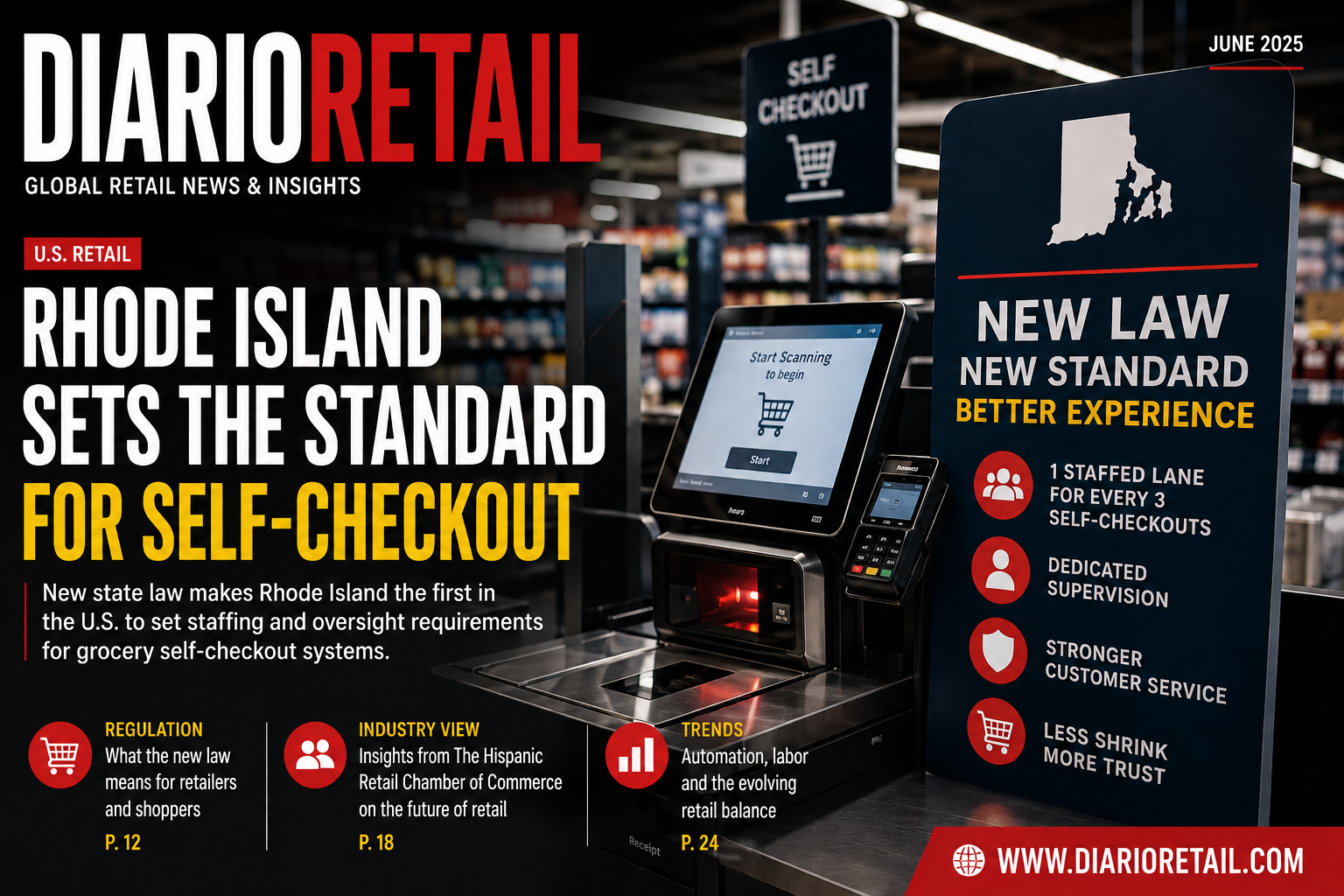
The new legislation makes Rhode Island the first U.S. state to establish specific operating requirements for grocery self-checkout systems. The measure could become a benchmark for future regulations nationwide, reigniting the debate over automation, customer experience, and workforce balance.
Diario Retail | U.S. Grocery Retail
The digital transformation of grocery retail continues to evolve—but now under a new regulatory framework.
Rhode Island has become the first state in the United States to enact legislation establishing specific operating standards for self-checkout systems in grocery stores. The law is designed to improve customer service, strengthen operational oversight, and reduce the risks associated with increasingly automated checkout operations.
While self-checkout technology has helped retailers improve efficiency, shorten wait times, and optimize labor resources, it has also raised concerns about inventory shrink, scanning errors, theft, and the changing role of frontline employees.
With this legislation, Rhode Island sets a precedent that may influence lawmakers and regulators in other states as they evaluate the future of checkout automation.
Key Highlights of the New Law
The legislation includes several important provisions:
- A minimum of one staffed checkout lane must be available for every three self-checkout stations in operation.
- Employees assigned to supervise self-checkout must be dedicated exclusively to that responsibility while on duty.
- Retailers that fail to comply with the law may face financial penalties.
- The legislation is intended to enhance customer service, improve operational security, and reduce retail shrink.
More Than a Technology Regulation
The rapid expansion of self-checkout systems over the past decade has been driven by retailers seeking greater operational efficiency, lower operating costs, and faster service.
However, experience across the industry has also demonstrated that automation without adequate supervision can contribute to increased inventory losses, customer frustration, and workforce concerns.
Rather than limiting technology adoption, Rhode Island’s approach focuses on establishing operational standards that encourage responsible implementation while maintaining a positive shopping experience.
A Potential Model for the Grocery Industry
Industry observers believe Rhode Island’s legislation could become a reference point for policymakers in other states considering similar measures addressing automation, labor practices, consumer protection, and loss prevention.
The development reinforces an important industry trend: success in grocery retail will depend not only on adopting new technologies, but also on integrating them in ways that improve operational performance while preserving customer service and employee engagement.
For supermarket operators, technology providers, and solution developers, the new regulatory landscape highlights the importance of designing automation strategies that balance innovation with operational excellence.
Industry Perspective | The Advisory Council of The Retail Chamber of Commerce (HRCOC)
“Technology should enhance—not replace—the customer experience. The future of grocery retail will be defined by retailers that successfully combine innovation, operational efficiency, and meaningful human interaction. Rhode Island’s legislation may represent the beginning of a broader national conversation about responsible automation in food retail.”
Diario Retail Perspective
Although the legislation currently applies only to Rhode Island, its implications extend well beyond state borders.
For years, the industry discussion centered on whether to automate. Increasingly, the more important question is how to automate responsibly, ensuring that technological innovation supports customer satisfaction, operational resilience, and long-term workforce sustainability.
For grocery retailers throughout Latin America and the United States, Rhode Island’s initiative provides an important case study on how public policy may shape the next generation of retail operations.
At a Glance | Rhode Island’s Self-Checkout Law
Before
- Retailers determined self-checkout deployment without specific statewide standards.
- Staffing levels around self-checkout varied by company policy.
- Oversight requirements were largely left to individual operators.
Now
- One staffed checkout lane is required for every three self-checkout stations.
- Dedicated supervision is required for self-checkout operations.
- Retailers may face penalties for non-compliance.
- Greater emphasis is placed on customer service, operational security, and shrink reduction.
Expected Industry Impact
- Increased staffing presence in checkout areas.
- Improved customer assistance.
- Enhanced loss prevention.
- A possible regulatory model for other U.S. states considering similar legislation.
