




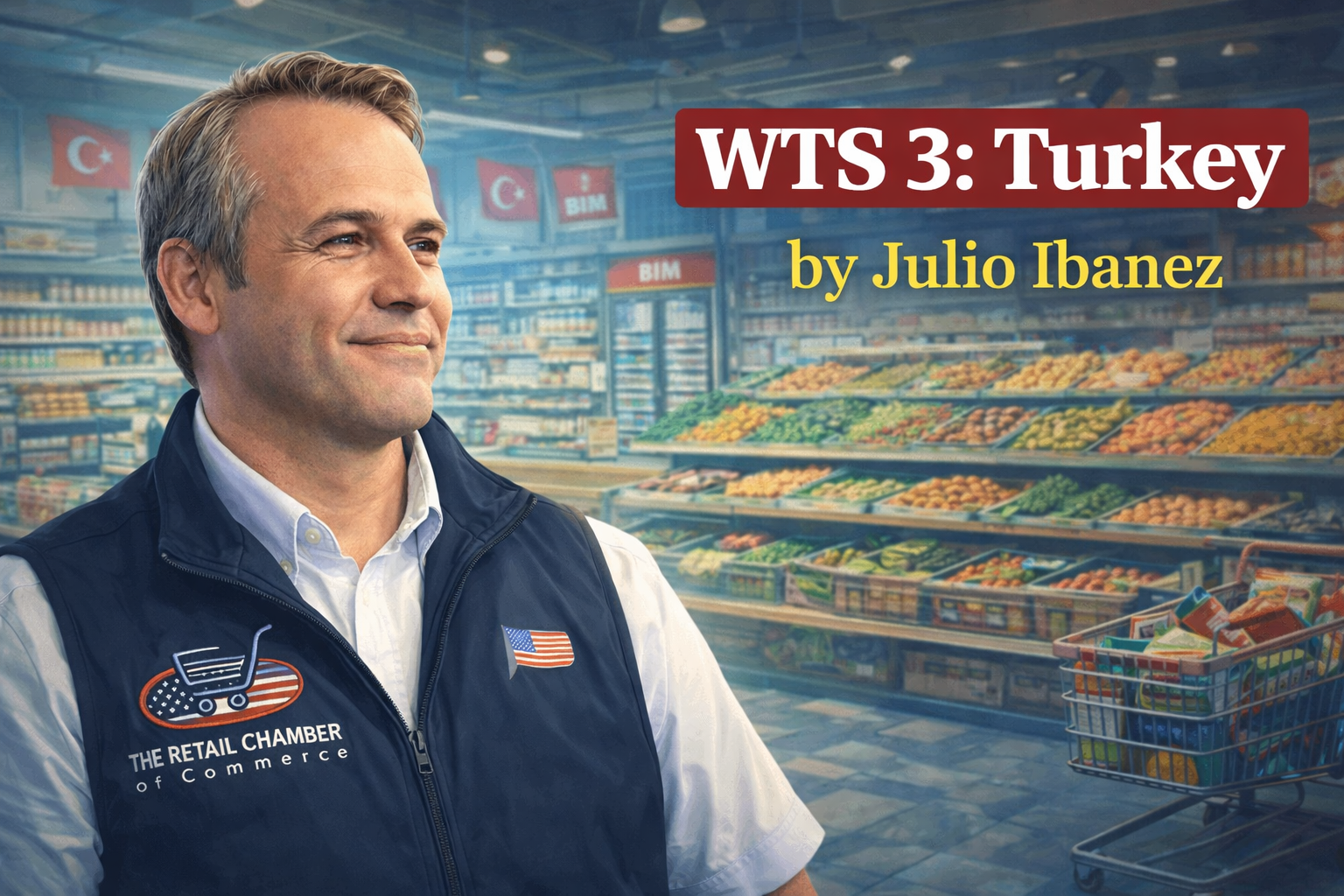
Turkey is not just a market.
It is a crossroads.
Geographically, it connects Europe and Asia.
Economically, it balances growth and volatility.
Culturally, it blends deep tradition with relentless modernity.
And nowhere is this tension more visible than in its supermarkets.
In Turkey, grocery retail is not about comfort or indulgence.
It is about efficiency, access, and survival at scale.
This is Turkey—where supermarkets are engineered to serve a nation of more than 85 million people, every single day.
Retail Under Pressure
To understand Turkish grocery retail, one must understand the environment in which it operates.
Turkey is defined by:
- Rapid urbanization
- High population density in major cities
- Inflationary pressure and currency volatility
- A deeply price-sensitive consumer
In this context, the supermarket is not a lifestyle destination.
It is a daily necessity.
Shoppers buy frequently.
Baskets are small.
Price matters more than almost anything else.
Efficiency is not a competitive advantage.
It is a requirement.
A Market Built for Discounters
Turkey is one of the clearest examples in the world of how hard discount formats can dominate an entire retail ecosystem.
Small stores.
Limited assortment.
Extreme operational discipline.
Dense urban penetration.
And no company represents this better than BİM.

BİM: Scale Through Simplicity
Founded in 1995, BİM rewrote the rules of Turkish grocery retail.
Its formula is deceptively simple:
- Extremely limited SKUs
- Heavy reliance on private label
- Spartan store design
- Ruthless cost control
- Unmatched store density
BİM does not compete on experience.
It competes on trust, price, and proximity.
With thousands of stores across Turkey—and expansion into neighboring markets—BİM has become more than a retailer.
It is infrastructure.
For many households, BİM is not an option.
It is the default.
Think of it as Aldi-level discipline, executed at emerging-market speed and scale.

Şok: The Neighborhood Discounters’ War
If BİM represents dominance, Şok represents competition at street level.
Backed by one of Turkey’s largest conglomerates, Şok mirrors much of the hard-discount philosophy:
- Compact stores embedded in residential areas
- High-frequency shopping
- Strong private label presence
- Aggressive pricing
What differentiates Şok is proximity warfare.
Stores are everywhere—often within steps of each other.
In Turkish cities, retail competition happens block by block, not by trade area.
This hyper-density creates a unique retail dynamic:
volume is won not by attraction, but by availability.

Migros: The Structured Counterbalance
While discounters dominate headlines, Turkey is not a one-format market.
Migros plays a very different role.
Originally founded with Swiss influence, Migros represents:
- Structured assortment
- Broader category depth
- Strong fresh and private label programs
- A more traditional supermarket experience
Migros serves the middle and upper-middle consumer, balancing price with quality and assortment.
In many ways, Migros is the stabilizer of Turkish retail—the bridge between European-style supermarkets and the brutal efficiency of discounters.
Where BİM strips retail to its core, Migros refines it.
Private Label as an Economic Tool
In Turkey, private label is not branding.
It is economics.
Private label allows retailers to:
- Control pricing in inflationary environments
- Reduce dependence on multinational brands
- Maintain margins while protecting consumers
BİM and Şok use private label as a weapon.
Migros uses it as a portfolio strategy.
Across formats, private label is no longer optional—it is foundational.
Tradition Never Disappears—It Adapts
Despite the dominance of modern formats, traditional commerce still exists:
- Open-air markets
- Neighborhood produce shops
- Bakers and butchers
But unlike many countries, these formats do not resist supermarkets.
They coexist.
Turkish consumers move fluidly between channels, choosing based on:
- Price
- Freshness
- Convenience
- Habit
The result is a retail ecosystem that is hybrid, pragmatic, and resilient.
Lessons for Global Retailers
Turkey offers some of the clearest lessons for operators worldwide:
- Extreme efficiency beats aesthetic retail in price-sensitive markets
- Store density can outperform store size
- Private label is a macroeconomic stabilizer, not just a margin lever
- Simplicity scales faster than complexity
For independent retailers, discounters, and emerging-market operators, Turkey is a masterclass in operating under pressure.
Final Thought
Turkey did not build its supermarket system to impress.
It built it to endure.
In a market shaped by volatility and growth, Turkish retailers learned that:
- Efficiency is culture
- Price is trust
- Access is loyalty
From the family-driven identity of Italy, we now stand in a market ruled by discipline, density, and scale.
And the journey continues.
Next Stop: Egypt
Turkey shows us what happens when efficiency becomes survival—
when scale, price discipline, and private label are pushed to their limits to serve a fast-growing, price-sensitive population.
But moving further east and south, the conversation evolves again.
From Turkey, the journey enters the Arab world—where supermarkets are no longer just retail formats, but instruments of social stability, food security, and economic balance.
Our next destination is Egypt.
A country of more than 110 million people, where:
- Modern supermarkets coexist with traditional commerce
- Inflation and currency pressure shape daily purchasing behavior
- Retailers operate under intense price sensitivity and regulatory influence
- Grocery stores play a critical role in feeding cities at massive scale
In Egypt, supermarkets are not designed to impress.
They are designed to hold the system together.
In Episode 4, we explore how Egyptian retailers navigate scale, volatility, and responsibility—while balancing modern trade, local supply, and the everyday realities of one of the world’s most densely populated nations.
From efficiency to resilience,
the world tour continues—always moving east.
